
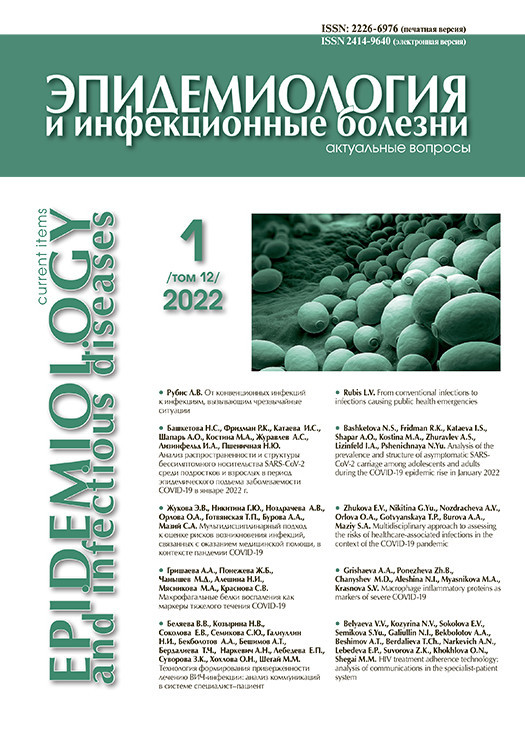
Year
Edition number
№1 / 2022
Exchange of experience
Rakityanskaya I.A., Ryabova T.S., Kalashnikova A.A.
Effect of alloferon on the cytotoxic activity of NK cells in patients with chronic Epstein-Barr virus infection115-120
Kryshen K.L., Volok V.P., Shustova E.Yu., Shipunov G.A., Zinchenko A.V., Samsonov M.Yu., Filon O.V., Shipaeva E.V.
Antiviral activity of favipiravir against novel delta and omicron SARS-CoV-2 variants110-114
Reviews and lectures
Shchipeleva I.A., Kretenchuk O.F., Korshenko V.A., Markovskaya E.I.
Current status and prospects for specific plague prevention101-109
Заметки из практики
Karpovich G.S., Kuimova I.V., Serova Yu.S.
СOVID-19 as a probable trigger factor for autoimmune diseases in children93-100
Original investigations
Matievskaya N.V., Volosach O.S., Kuzmich I.A.
Pseudomonas aeruginosa infection in inpatients of different profiles: clinical and microbiological aspects87-92
Kovalev D.A., Kuznetsova I.V., Zhirov A.M., Serdyuk N.S., Zhilchenko E.B., Ponomarenko D.G., Vodopyanov A.S., Vodopyanov S.O., Kulichenko A.N.
Genetic typing of Brucella melitensis strains on the basis of variability analysis of INDEL loci81-86
Ayugin N.I., Zarva I.D., Gavrilova T.A., Khakimova M.I., Botvinkin A.D.
Use of GIS technologies to analyze the spread of enteroviral infection in the urban environment76-80
Bykov I.P., Sergeev A.G., Mishchenko V.A., Vyalykh I.V., Toporkova M.G., Vyatkina L.G., Makhorina T.V.
Clinical forms of tick-borne viral encephalitis in persons with co-infection70-75
Davidova N.G., Golubkova A.A., Platonova T.A.
Strategic directions for measles infection control in healthcare facilities (according to the analysis of the outbreak in a children hospital)64-69
Omarova Kh.G., Makashova V.V., Ponezheva Zh.B.
The features of the course of HBV infection during antiviral therapy60-63
Volkova S.B., Podymova A.S.
Demographic and clinical characteristics of patients with new-onset HIV/CHC coinfection with the known HCV genotype53-59
Stepanova E.V., Leonova O.N., Buzunova S.A.
Analysis of the established disability group in HIV-infected patients46-52
Belyaeva V.V., Kozyrina N.V., Sokolova E.V., Semikova S.Yu., Galiullin N.I., Bekbolotov A.A., Beshimov A.T., Berdalieva T.Ch., Narkevich A.N., Lebedeva E.P., Suvorova Z.K., Khokhlova O.N., Shegai M.M.
HIV treatment adherence technology: analysis of communications in the specialist-patient system39-45
Grishaeva A.A., Ponezheva Zh.B., Chanyshev M.D., Aleshina N.I., Myasnikova M.A., Krasnova S.V.
Macrophage inflammatory proteins as markers of severe COVID-1935-38
Zhukova E.V., Nikitina G.Yu., Nozdracheva A.V., Orlova O.A., Gotvyanskaya T.P., Burova A.A., Maziy S.A.
Multidisciplinary approach to assessing the risks of healthcare-associated infections in the context of the COVID-19 pandemic25-34
Zadoroshnyi A.V., Pshenichnaya N.Yu., Akimkin V.G.
Features of the clinical course and the COVID-19 epidemic process in the communities of various planning patterns18-24
Epidemic situation
Bashketova N.S., Fridman R.К., Kataeva I.S., Shapar A.O., Kostina M.A., Zhuravlev A.S., Lizinfeld I.A., Pshenichnaya N.Yu.
Analysis of the prevalence and structure of asymptomatic SARS-CoV-2 carriage among adolescents and adults in Saint Petersburg during the COVID-19 epidemic rise in January 202211-17
Problem-solving articles
Rubis L.V.
From conventional infections to infections causing public health emergencies6-10